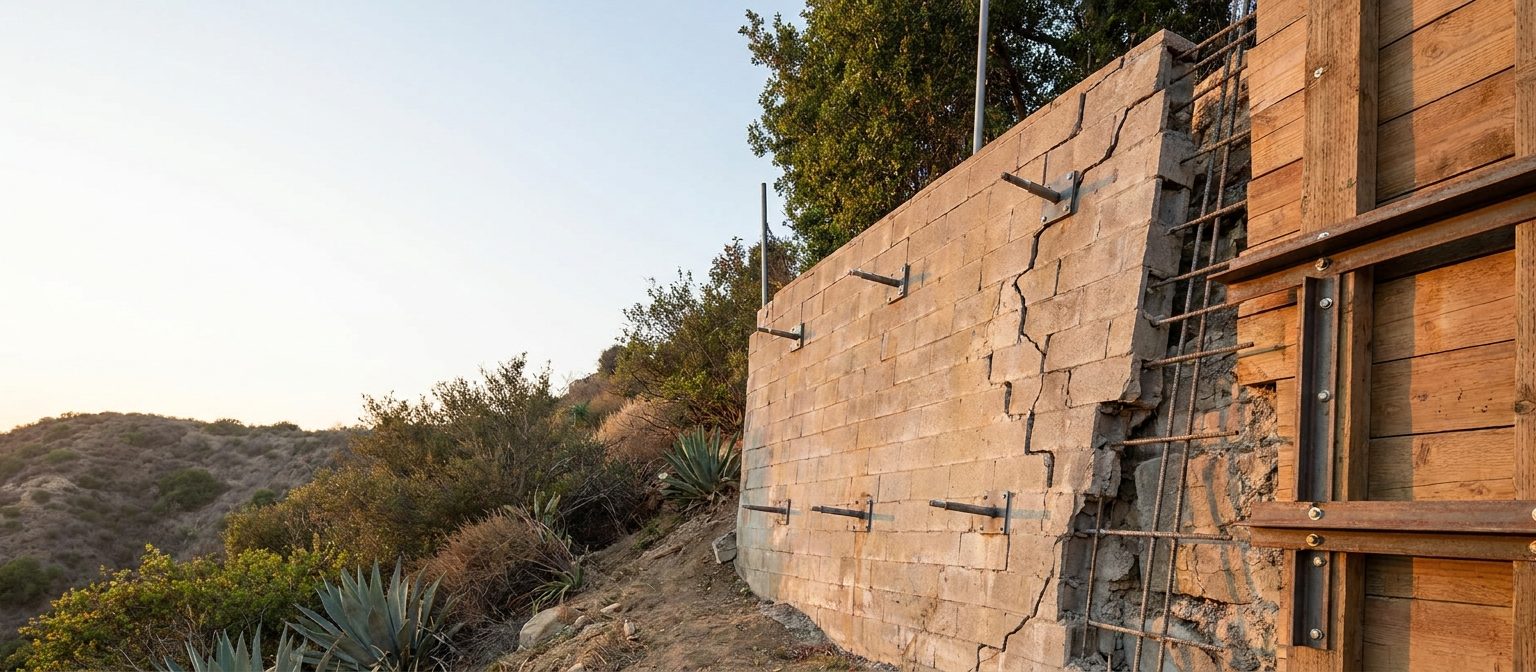
Long Canyons, Slow Movement
Brentwood repairs cluster up Mandeville, Sullivan and Kenter Canyon, on properties strung along roads that run miles from San Vicente Boulevard into the Santa Monica Mountains. These are cut lots on canyon walls, and the walls holding them are typically retaining native ground rather than placed fill.
Native-ground failures behave differently from fill failures. They tend to be slower, more uniform, and driven by groundwater moving through the hillside rather than by surface water collecting behind a face. The tell is a wall that moves a little every year without any obvious storm event to blame, and where drainage retrofits alone often do not settle it.
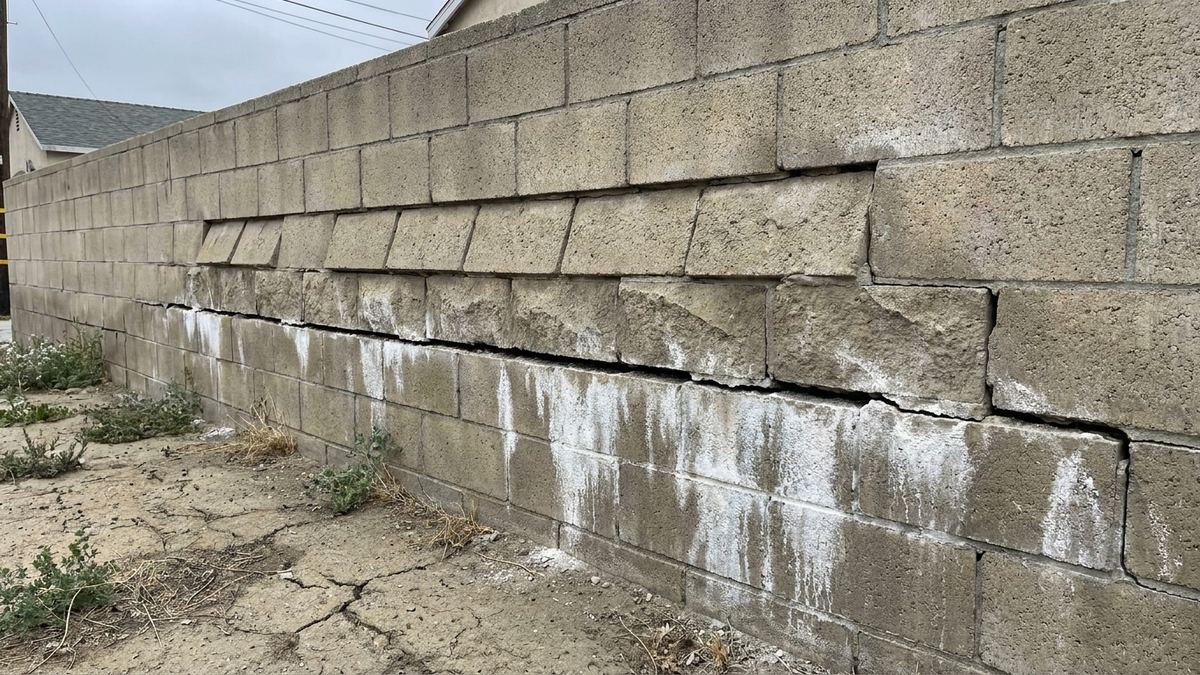
What We Look For on a Brentwood Wall
- Consistent annual movement. A few millimetres a year rather than a sudden shift. It adds up and it points at groundwater.
- Seepage that continues into summer. Surface water stops; groundwater does not.
- A whole run moving uniformly. Rather than one bulging panel — characteristic of hillside movement rather than local pressure.
- Cracking that reopens after repair. The classic sign that the cause was never addressed.
- Fence lines and paths going out of true. The ground is moving, not just the wall.
What Is Actually Causing It
Groundwater within the hillside, and in some cases slow slope creep. Both are outside what a conventional drainage retrofit reaches, which is why Brentwood canyon repairs more often involve subsurface drainage or anchors than a simple gravel chimney behind the face.
How We Repair Walls in Brentwood
Subsurface drainage.
Reaching the water where it actually is, rather than intercepting surface flow that was never the problem.
Anchors into stable ground.
Holding the wall against movement that drainage alone will not stop.
Piers where creep is established.
Reaching past the moving zone rather than resisting within it.
Plan the logistics honestly.
On a single-access canyon road, how material and equipment reach the site is a real part of the scope.
Assessment Before Anything Else
Every Brentwood repair starts with working out which of those causes you actually have, because the wrong diagnosis is how people spend a great deal of money without fixing anything. The visit is free, you get an itemised written scope, and if a repair will hold we say so — and if it will not, we say that too. Permits, where the work needs them, go to LADBS.
Retaining Wall Repair FAQ's for Brentwood
My wall moves a little every year. Is that normal?
It is common up these canyons and it is not something to live with indefinitely. Slow consistent movement usually means groundwater or slope creep rather than surface drainage, and those need different solutions.
We fixed the drainage and it still moves. Why?
Because the water causing it is probably within the hillside rather than behind the wall. Surface drainage cannot reach that, and subsurface work or anchoring usually can.
Is access up Mandeville really a factor?
A significant one. Single-access canyon roads with no staging space limit equipment and lengthen programmes, and it belongs in the quote rather than as a surprise.
Do repairs here need hillside review?
Frequently. Brentwood is City of Los Angeles, so that is LADBS with the hillside ordinance applying on the canyon lots.
Does the marine air matter for anchors?
Yes — corrosion protection on tiebacks and embedded steel is specified for the environment. Salt air reaches further up these canyons than people assume.
Repairs We Carry Out in Brentwood
Each of these covers one condition in detail — what it looks like, what causes it and what fixing it involves. Or start from the retaining wall repair overview.
If the wall turns out to be past repair we also build new — see retaining wall installation in Brentwood, hillside and slope work, or everything we do in Brentwood.