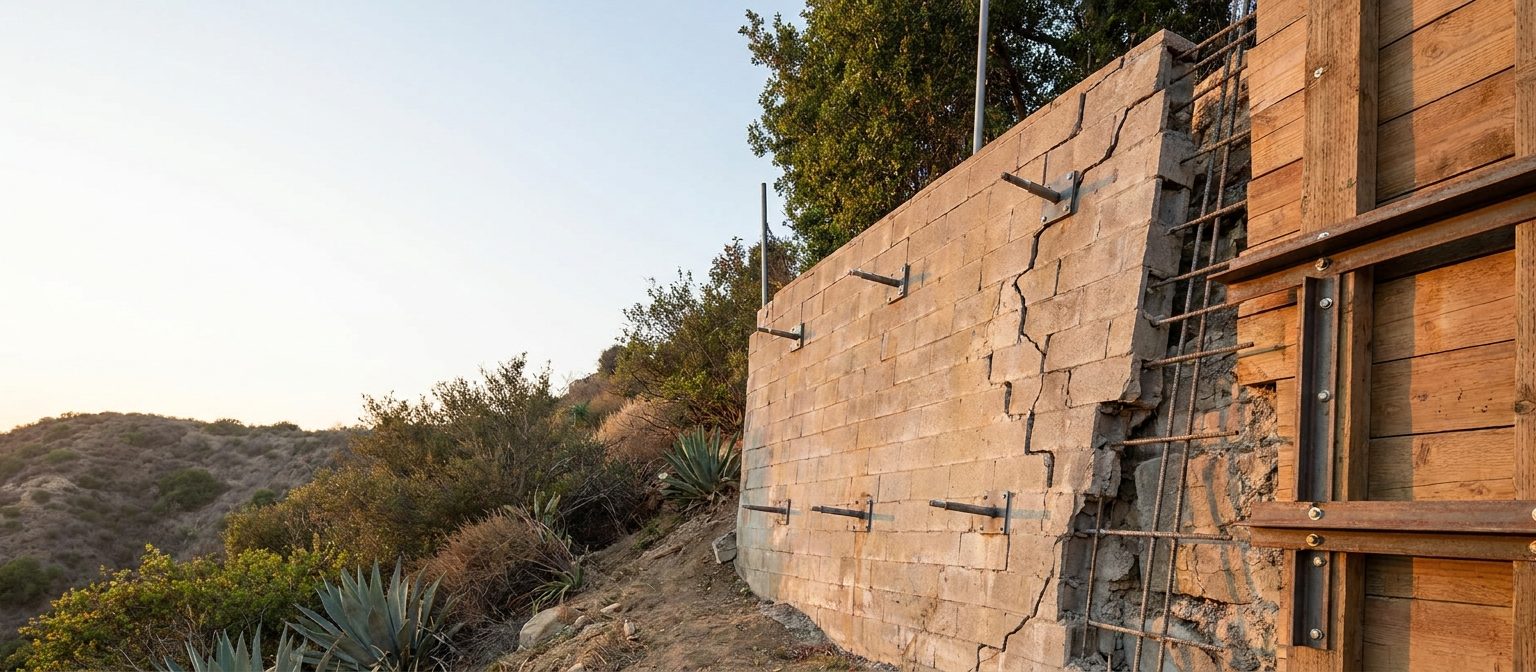
Below the Forest, After the Fire
La Cañada Flintridge sits directly beneath the Angeles National Forest, and the repair work here is shaped by that more than by soil or slope. The streets below the forest line, the properties along the Arroyo Seco, and the neighbourhoods around Descanso Gardens all sit on the alluvial fan that the San Gabriels have been building for a very long time.
The material coming off that range is coarse — sand, gravel and cobble — and it drains well until it does not. What damages walls here is less hydrostatic pressure than sheer volume and velocity: water and debris arriving fast down a fan, undercutting toes, scouring around the ends of walls, and occasionally loading a structure with material rather than just water.
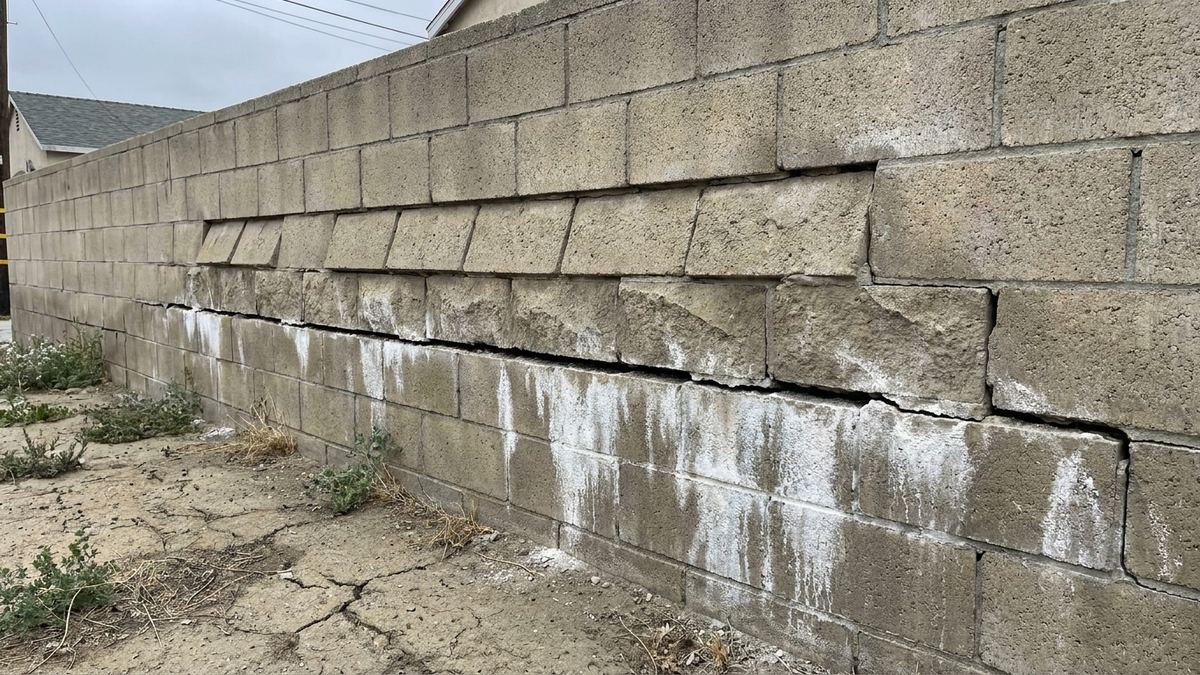
What We Look For on a La Cañada Flintridge Wall
- Scour around the end of a wall. Flow going around rather than through, taking the ground with it.
- Cobble and debris deposited against the face. Evidence of what actually arrived, and a clue to the volume.
- Undercutting at the toe. The characteristic fan-country failure, and often invisible until someone digs.
- Impact damage rather than pressure cracking. Chipping and localised damage from material that was moving.
- Sudden failure after a first post-fire rain. The sequence that does most of the damage in this part of the county.
What Is Actually Causing It
Volume and velocity off a steep, geologically young range, made considerably worse by fire. A burned slope above a property sheds far more water and delivers material with it, and the walls below were generally designed for neither.
How We Repair Walls in La Cañada Flintridge
Establish what the wall is actually being asked to hold.
Soil pressure and debris impact are different load cases with different answers.
Protect and armour the toe.
Where scour is the mechanism, the fix is at the base rather than behind the wall.
Route flow around rather than into.
Channels and deflection, which is usually cheaper and more effective than resisting.
Recommend a purpose-built structure where that is the honest answer.
A retaining wall is not debris protection, and we will not let one be mistaken for the other.
Assessment Before Anything Else
Every La Cañada Flintridge repair starts with working out which of those causes you actually have, because the wrong diagnosis is how people spend a great deal of money without fixing anything. The visit is free, you get an itemised written scope, and if a repair will hold we say so — and if it will not, we say that too. Permits, where the work needs them, go to the City of La Cañada Flintridge.
Retaining Wall Repair FAQ's for La Cañada Flintridge
Will a taller wall protect my house from debris?
No, and this is the most important thing on this page. Retaining walls are designed for static soil pressure. Debris flow applies dynamic impact with rock in it, and resisting that requires a structure engineered for that load case.
The wall failed after the first rain following a fire. Why?
Because a burned slope sheds several times the runoff and carries material with it. That first storm is when most of the damage in these foothills happens.
What is undercutting?
Water removing material from beneath the footing. It is the typical failure here and it is frequently invisible from above until the wall moves.
Does La Cañada have its own building department?
Yes, with its own hillside requirements — not the LA County or LADBS process.
Is there a best time to do this work?
Before the wet season, and after a fire that is urgent rather than preferable. The window that matters is the calendar one, not the construction one.
Repairs We Carry Out in La Cañada Flintridge
Each of these covers one condition in detail — what it looks like, what causes it and what fixing it involves. Or start from the retaining wall repair overview.
If the wall turns out to be past repair we also build new — see retaining wall installation in La Cañada Flintridge, hillside and slope work, or everything we do in La Cañada Flintridge.