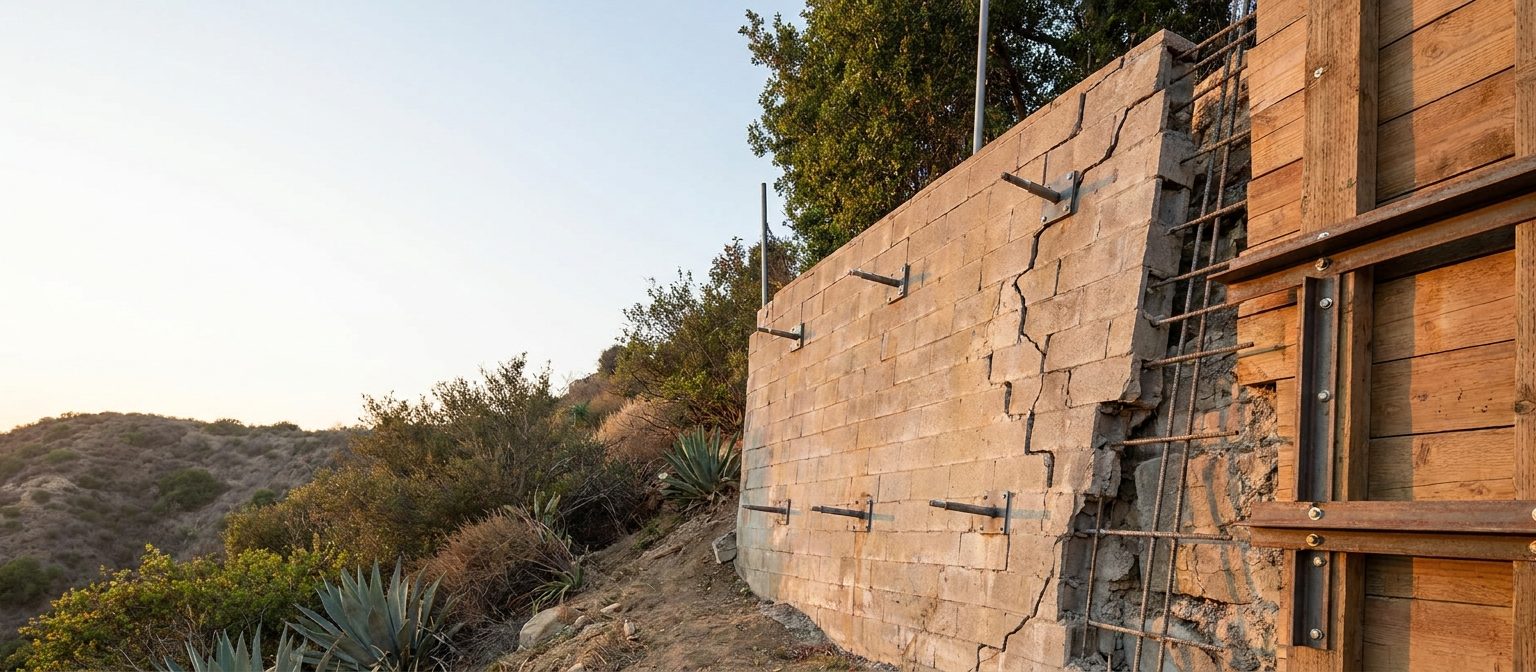
Walls Founded Above and Below the Rock
Thousand Oaks repairs come down to one variable more than any other: whether the wall was founded on the Conejo volcanic rock or on the soil sitting above it. On the slopes around Wildwood Regional Park and up toward the Conejo Grade, that rock can be at the surface in one spot and several feet down twenty yards away.
A wall crossing that boundary is a wall with two different foundations, and it will eventually tell you so. The rock end stays exactly where it was put; the soil end moves seasonally with the expansive material. What shows up is cracking concentrated at the transition, and it is a diagnosis you will not reach without knowing what is under each end.
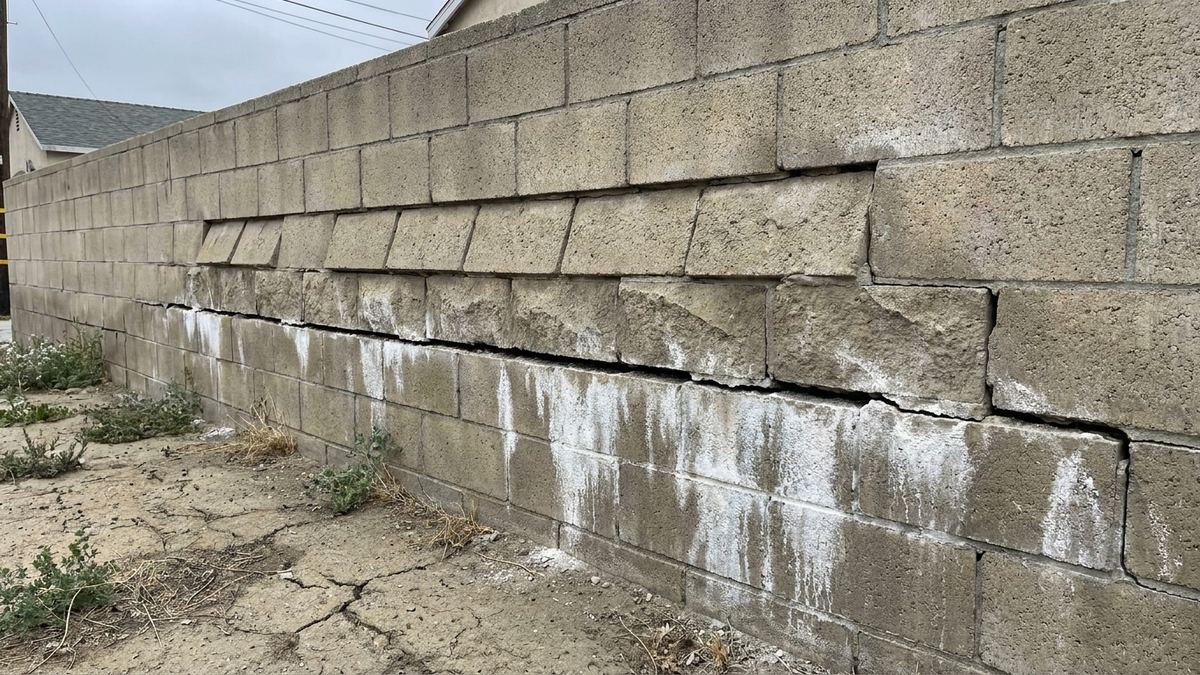
What We Look For on a Thousand Oaks Wall
- Cracking concentrated at one point along a run. Usually where the founding material changes.
- One end stable, the other moving. The signature of a wall bridging rock and soil.
- Seasonal opening and closing of a crack. Expansive soil at one end working through its annual cycle.
- Movement on the open-space boundary. Properties backing onto Wildwood and Los Robles get drainage from land nobody manages.
- Fire-affected slope above. Changes the volume and the material arriving at the wall.
What Is Actually Causing It
Differential foundation conditions, made visible by expansive soil above the rock. Add wildland drainage on the open-space boundaries and post-fire runoff, and you have the three things that produce most of the repair work in the Conejo Valley.
How We Repair Walls in Thousand Oaks
Establish the founding condition along the whole run.
Not one test pit — the point is how it changes.
Underpin the soil-founded end.
Bringing both ends onto comparable bearing so they stop fighting each other.
Introduce a movement joint.
Where founding conditions genuinely differ, letting the wall articulate is often better than forcing it to be rigid.
Manage the wildland drainage.
On open-space boundaries, intercepting flow before it reaches the wall.
Assessment Before Anything Else
Every Thousand Oaks repair starts with working out which of those causes you actually have, because the wrong diagnosis is how people spend a great deal of money without fixing anything. The visit is free, you get an itemised written scope, and if a repair will hold we say so — and if it will not, we say that too. Permits, where the work needs them, go to the City of Thousand Oaks.
Retaining Wall Repair FAQ's for Thousand Oaks
Why does my wall only crack in one place?
Very often because the ground under it changes there — rock at one end, soil at the other. Two different foundations under one wall produce exactly that pattern.
Is Thousand Oaks in Los Angeles County?
No, Ventura County, with its own city building department. We cover it as part of our west-side work, but the regulatory context is genuinely different from our LA County areas.
Should the crack be filled?
Not before understanding it. If it is moving seasonally, filling it rigidly just moves the problem. A movement joint is sometimes the correct answer instead.
My property backs onto open space. Does that matter?
It does — you are receiving drainage from land nobody maintains, and after a fire that changes substantially in both volume and content.
Will hitting rock make the repair more expensive?
It makes excavation slower and the resulting foundation better. It cuts both ways, which is why we establish it before pricing.
Repairs We Carry Out in Thousand Oaks
Each of these covers one condition in detail — what it looks like, what causes it and what fixing it involves. Or start from the retaining wall repair overview.
If the wall turns out to be past repair we also build new — see retaining wall installation in Thousand Oaks, hillside and slope work, or everything we do in Thousand Oaks.